Most apparel knits are produced on circular knitting machines. As the name says, they work around a cylinder and deliver the fabric as a tube. The terms you hear when buying fabric, machine diameter and gauge, describe exactly these machines.
How the machine works
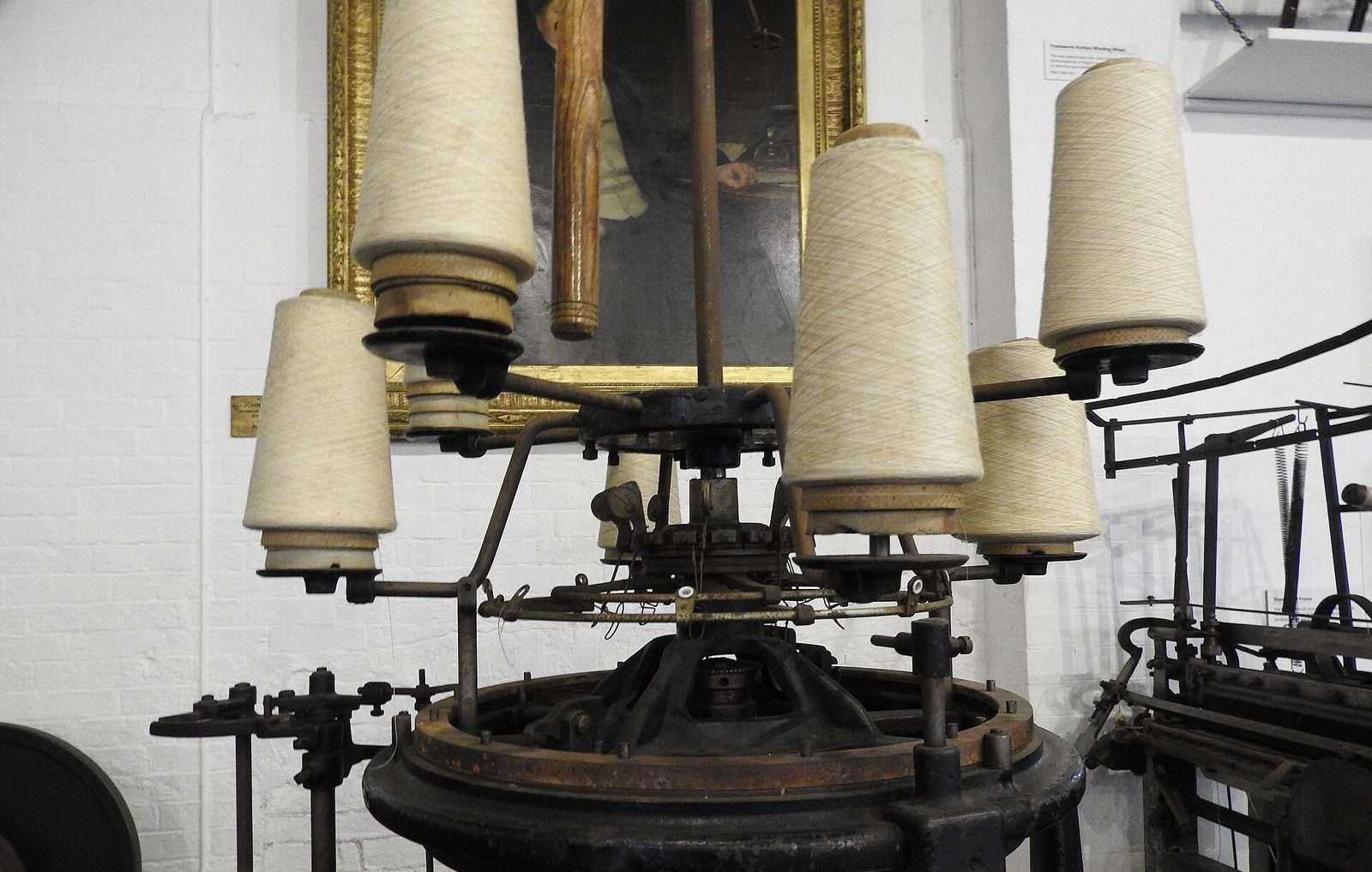
At the centre of the machine is a cylindrical bed carrying hundreds or thousands of needles. Cams move the needles up and down. As a needle rises it clears the old loop, catches the newly fed yarn, and on its way down pulls that yarn through the old loop to form a new stitch. As the cylinder turns, the movement repeats course by course and the fabric grows downwards.
Yarn arrives from feeders placed around the machine; their number sets how many courses are produced per revolution. The take-down unit below the cylinder collects the fabric at a controlled tension.
The main parts
- Needles and needle bed: the parts that actually form the loop, carried on the cylinder and, where present, the dial.
- Cam system: the tracks that define the needle movement and therefore the knitting pattern.
- Yarn feeders: units that deliver yarn to the needles at a steady tension.
- Creel: the frame holding the yarn packages.
- Take-down unit: the section collecting the fabric at even tension.
What machine diameter means
Diameter is expressed in inches. The larger the diameter, the longer the needle circle, the more needles it carries and the wider the resulting tube. Final fabric width is not set by diameter alone: yarn thickness, stitch density and finishing all affect it. Even so, diameter is the basic parameter deciding which width can be produced on which machine.
In practice the diameter is chosen together with the target width and the cutting plan, so it has a direct effect on cost.
What gauge means
Gauge is the number of needles per inch, written for example as E20. A higher gauge means needles sit closer together, so finer yarn produces a denser and smoother surface. Lower gauges are used with thicker yarn for bulkier fabrics with larger loops.
Yarn count and gauge belong together. Running thick yarn on a very fine machine breaks needles and spoils the surface, while very fine yarn on a coarse machine gives a sparse, weak fabric. So fabric development starts from the target weight and hand feel, and the yarn and gauge combination follows.
Single-bed and double-bed machines
Single-bed machines carry needles only on the cylinder and knit single jersey, piqué and similar structures. Double-bed machines add a horizontal dial, so two needle groups work together to knit rib, interlock, selanik and punto milano. Double-bed fabrics are fuller and dimensionally more stable but consume more yarn for the same appearance.
How settings change the fabric
Even with the same machine and the same yarn, different fabrics are possible. Stitch length changes weight and stretch, yarn tension affects surface evenness, and uneven feeding shows up as lines. Machine speed matters too: it raises output but can amplify tension variation. That is why a sample is taken at the start of a run, measured, and the settings fixed against the targets.
Meyas Tekstil runs circular knitting machines in various diameters and gauges in its own facility in Kahramanmaraş. We choose the machine and the settings for your product and follow the measurements with our own team from the knitting exit to shipment. Describe the fabric you are aiming for in the quote form and we will define the right line and sample plan together.
Next step
Shall we develop the right fabric for your product?
Share your target weight, width and end use; we will get back with suitable constructions and sample options.
Request sample / quote ↗